A torpedo cigar has a pointed, tapered head, a straight body and an open foot. You light it like any other cigar and cut only the point. Holt's Cigar Company puts the usual size around 6.125 x 52, the dimensions of the Montecristo No. 2.
Torpedo vs. belicoso vs. pirámide
The names overlap, and the reference books admit it. Cigar Aficionado's glossary still gives the old meaning: "a closed foot, a pointed head and a bulge in the middle." Holt's says most torpedoes sold today have neither the closed foot nor the bulge.
| Shape | What it looks like | Typical size |
|---|---|---|
| Torpedo (modern) | Pointed head, straight body, open foot | About 6 1/8 x 52 |
| Pirámide | Tapers the whole way from a wide foot to a point | 6 to 7 in; 40 ring at the head, 52 to 54 at the foot |
| Belicoso | Shorter, rounder taper at the head | 5 to 5 1/2 in, about 50 ring |
| Perfecto | Both ends tapered, bulge in the middle | Varies |
The pirámide and belicoso sizes come from Cigar Aficionado's Cigar Shapes, Sizes And Colors, which says torpedoes "generally fit into the pyramid category." Holt's goes further: the Montecristo No. 2 has no bulge and no closed foot, "and so is really a... Pyramid."
Cuban names follow the pirámide side. Cigar Aficionado lists the Partagás Serie P No. 2, a 6 1/8 x 52 Cuban, as a pirámide. Most American shops would call the same cigar a torpedo.
The name does not settle it either. Our catalog files 48 rated, USD-priced cigars as Torpedo, 26 as Belicoso and 10 as Pyramid. These are catalog labels, not a definitive shape classification. Ask the shop for the maker’s format and dimensions.
Torpedo cigar sizes
Use the shape table above as a starting point, then check the particular cigar. Our Torpedo category includes other figurados, so a category average can mislead someone looking for a straight body with a pointed head.
The corrected Hemingway Short Story Maduro record is Figurado and no longer enters the Torpedo pool. The ranked pool still includes the Plasencia Alma Fuerte Salomon. Its inclusion reflects catalog classification rather than a claim that every entry has the modern torpedo shape.
The Liga Privada No. 9 Flying Pig has a catalog specification that conflicts with Drew Estate’s product page. We retain its recorded rating and reference price, but withhold its size illustration and dimension claims pending correction. Check the maker before choosing that format.
Why makers taper the head
Holt’s explains that the taper focuses smoke through a smaller opening and that figurados require more rolling skill. That does not make every torpedo more expensive than every straight-sided cigar.
We found three catalog pairs with the same blend, length and ring gauge. The torpedo has the higher USD reference price in each. These historical observations do not prove what causes a retailer’s current price difference.
| Same blend, same size | Torpedo | Toro |
|---|---|---|
| My Father Flor de las Antillas, 6 x 52 | $7.50 | $6.90 |
| Rocky Patel Decade, 6.5 x 52 | $10.50 | $10.00 |
| The Edge Corojo, 6 x 52 | $8.95 | $6.60 |
The differences range from 50 cents to $2.35. Three pairs are a small sample, and current offers may differ. These prices use the September 21, 2026 catalog snapshot and are for one cigar.
How to cut a torpedo cigar
Cut a little, test the draw, then remove more only if needed. Taking too much off in one cut can damage the cap. Keep your fingers clear of the blade.
Gary Korb’s Famous Smoke Shop guide describes these approaches:
- Straight cut: start around a quarter-inch from the tip, test the draw and trim further if necessary.
- Table method: rest a straight cutter flat on a table and insert the tip into its opening before cutting.
- Angled cut: a diagonal cut can create a larger opening. Start conservatively.
- Avoid the shoulders: cutting too far down risks unraveling the wrapper.
| Cutter | On a torpedo? | Why |
|---|---|---|
| Straight guillotine | Yes | Allows a small initial cut and further trimming |
| V-cutter | Yes | Makes a wedge in the tapered head |
| Punch | Poor fit | Designed to bore into a flatter cap |
The V-cut
Korb also recommends a V-cutter for tapered heads. Choose the method that lets you make a clean opening without removing too much cap.
Why a punch is a poor fit
A punch needs a surface it can bore into; a sharp point gives it little purchase. Holt’s cutting guide recommends straight or V-cutters for this shape. See our cigar accessories guide for cutter types.
How to smoke a torpedo
The foot is open, so light a modern torpedo the same way you light a toro. Our cut, light and smoke guide covers toasting the foot. The head is the only part that needs different handling.
- Start with a small cut. A big opening puts more tobacco in your mouth and defeats the taper.
- Re-cut when it tightens. Holt's says moisture from your mouth or oils in the cigar can tighten the draw. Then cut a little deeper with a guillotine.
- Check the strength on the box, not the shape. Our catalog lists 13 USD-priced Torpedo records as Medium, 20 as Medium-Full and 9 as Full; 6 have no disclosed strength.
If you already like a blend’s robusto or toro, its torpedo can offer a useful comparison. Compare the actual retailer prices before paying more for the shape. For more on how size changes a smoke, read our ring gauge and length guide and cigar shapes guide.
The 12 best-rated torpedoes in our catalog
We took 48 Torpedo records with a rating and positive USD price, ranging from $5.45 to $29.17 with a $10.00 median. We kept the best-rated cigar from each brand, breaking ties on lower price.
Prices are single-cigar USD references from the September 21, 2026 catalog snapshot. They include historical observations, not verified current offers. GBP records are excluded without conversion. Check current retail prices and availability.
Price of 12 torpedoes, one per brand
The top rating, 4.90, belongs to the Liga Privada No. 9 Flying Pig at $20.83. The cheapest of the 12 is the The Edge Habano Torpedo at $6.55. The dearest is $20.83. Ratings span only 0.25 of a point.
top rating (4.90) — $20.83the other 11 picks
- The Edge Habano Torpedo$6.55
- 601 Red Label Habano Torpedo$7.95
- Casa Turrent Serie 1973 Torpedo$9.00
- Kristoff Corojo Limitada Torpedo$10.00
- My Father Le Bijou 1922 Torpedo Box Pressed$11.40
- Alec Bradley Prensado Torpedo$14.15
- Cuba Aliados by Ernesto Perez-Carrillo Torpedo$14.75
- Undercrown Flying Pig$15.00
- Oliva Serie V Melanio Maduro Torpedo$16.63
- Plasencia Alma Fuerte Salomon$17.00
- Padron 1964 Anniversary Series Torpedo Natural$17.80
- Liga Privada No. 9 Flying Pig$20.83
| Cigar | Rating | Price |
|---|---|---|
| Liga Privada No. 9 Flying Pig | 4.9 | $20.83 |
| My Father Le Bijou 1922 Torpedo Box Pressed | 4.85 | $11.40 |
| Padron 1964 Anniversary Series Torpedo Natural | 4.85 | $17.80 |
| Alec Bradley Prensado Torpedo | 4.75 | $14.15 |
| Oliva Serie V Melanio Maduro Torpedo | 4.75 | $16.63 |
| The Edge Habano Torpedo | 4.7 | $6.55 |
| Casa Turrent Serie 1973 Torpedo | 4.7 | $9.00 |
| Cuba Aliados by Ernesto Perez-Carrillo Torpedo | 4.7 | $14.75 |
| Undercrown Flying Pig | 4.7 | $15.00 |
| Plasencia Alma Fuerte Salomon | 4.7 | $17.00 |
| 601 Red Label Habano Torpedo | 4.65 | $7.95 |
| Kristoff Corojo Limitada Torpedo | 4.65 | $10.00 |
Read this as a catalog ranking, with three caveats.
- Liga Privada and Undercrown are separate catalog brands, so both Flying Pig records qualify.
- The Plasencia Salomon illustrates why a Torpedo category can be broader than the modern shape definition; the Short Story Maduro is now classified as Figurado and excluded.
- The Partagás Serie P No. 2 has a GBP price and is excluded. The duplicate Ashton VSG record no longer supplies a separate rating or price.
Two formats near the end of the ranking
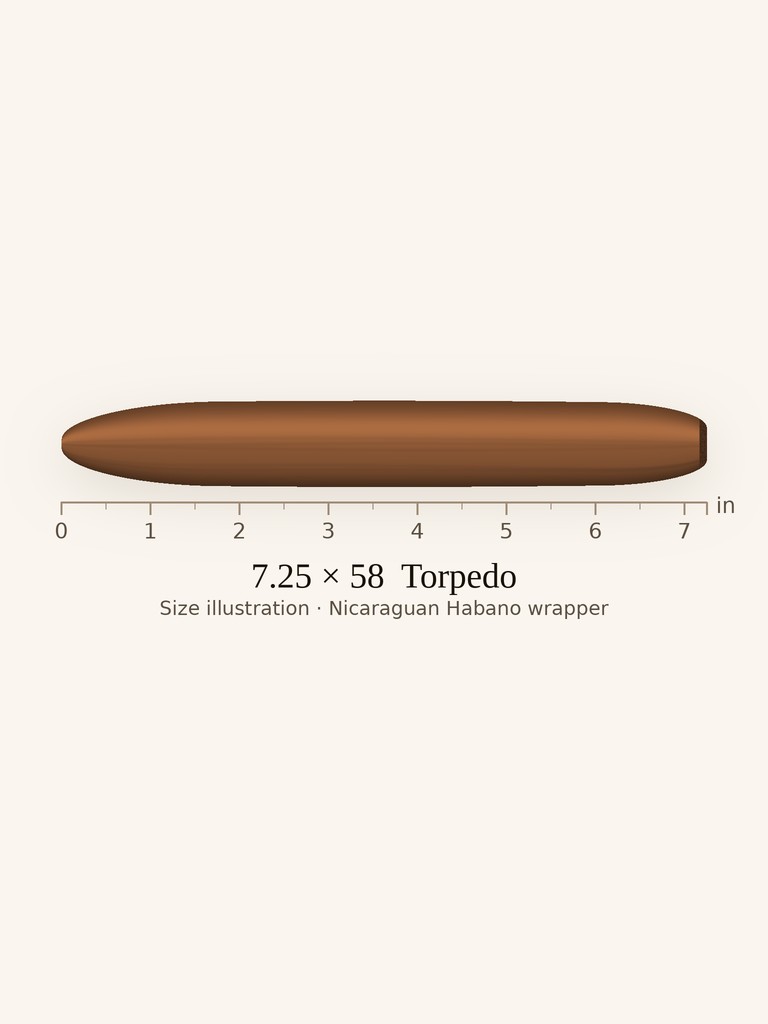
The Plasencia Alma Fuerte Salomon rates 4.7 at a $17.00 reference price. Its Salomon name signals a format to check separately from the standard torpedo profile. It ranks tenth under this catalog’s one-per-brand rule.
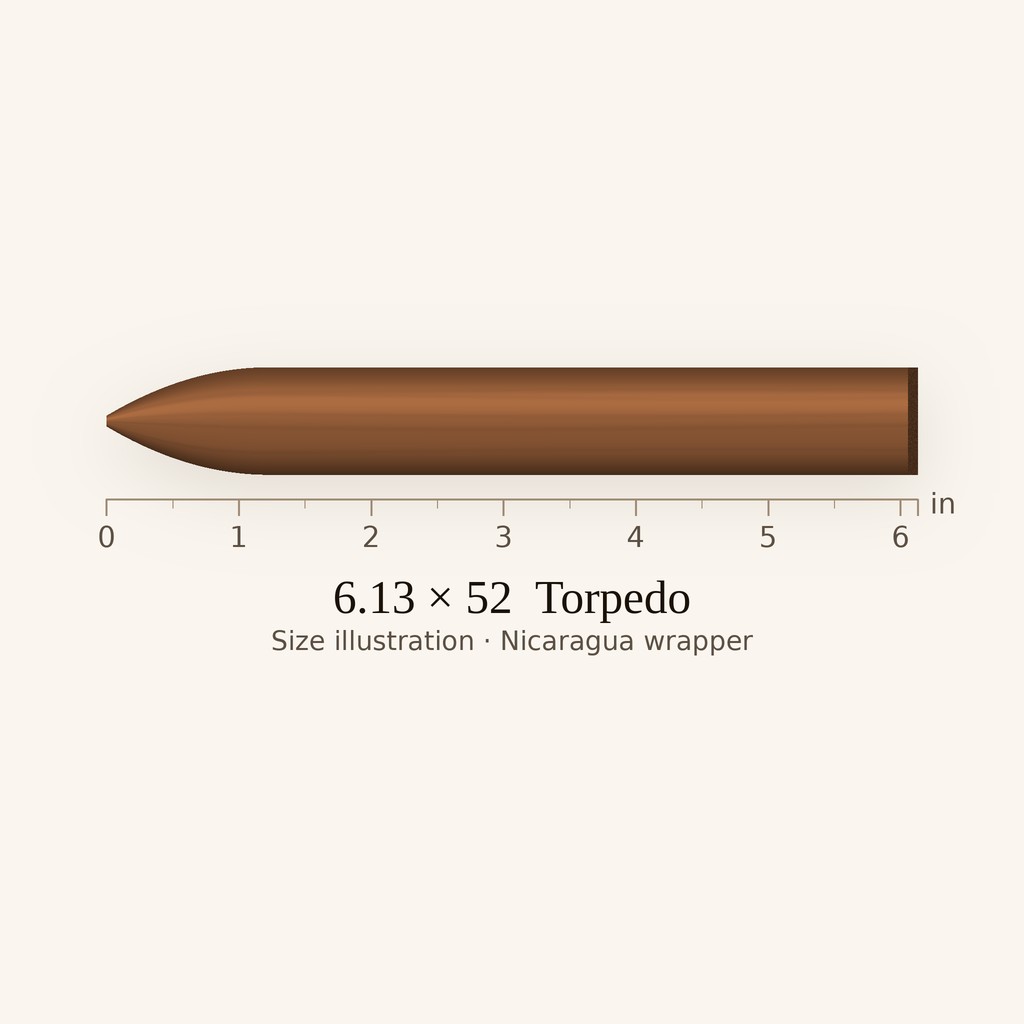
The 601 Red Label Habano Torpedo rates 4.65 at $7.95 and takes eleventh. Its recorded format is 6.13 x 52 with a Medium-Full strength label and Nicaragua origin.
The cheapest record in the whole pool, Carlos Torano Exodus 1959 Torpedo, has a $5.45 reference price and rates 4.55. It misses the twelve. The picker below uses catalog references; it does not check current offers.
Interactive
Pick a torpedo
The 12 one-per-brand picks from 48 catalog torpedoes. Set a ceiling; it returns the best-rated pick you can buy.
Best pick at or under $10.00: The Edge Habano Torpedo, rated 4.70 at $6.55.
What is a torpedo cigar?
A torpedo is a cigar with a pointed, tapered head, a straight body and an open foot. Holt's puts the usual size at about 6 1/8 x 52. The older definition, still in Cigar Aficionado's glossary, adds a closed foot and a bulge in the middle, but few cigars sold today have them.
What is the difference between a torpedo and a belicoso?
A belicoso is shorter, with a shorter and rounder taper at the head. Cigar Aficionado and Holt's both give 5 to 5 1/2 inches with a ring of about 50. A modern torpedo is usually about 6 1/8 x 52 with a sharper point.
How do you cut a torpedo cigar?
Cut the very tip with a straight cutter, take a draw, and cut a little more if it is tight. A V-cutter with an inverted blade also works. Do not cut deep in one go, because the wrapper can start to unravel.
Can you use a punch on a torpedo?
A punch is a poor fit for a pointed head because it is designed to bore into a flatter cap. Use a straight cutter or V-cutter, taking a conservative first cut and checking the draw before removing more.
Are torpedo cigars stronger?
Not because of the shape. Strength comes from the blend. Our catalog lists 13 USD-priced Torpedo records as Medium, 20 as Medium-Full and 9 as Full; 6 have no disclosed strength. The taper concentrates the smoke, which can taste more intense, but the leaf sets the strength.
Why are torpedo, cigar and hoagie grouped together?
They were a group in the New York Times Connections puzzle No. 694 on May 5, 2025: baton, cigar, hoagie and torpedo, "Things That Are Long and Cylindrical," per Game Rant. Torpedo and hoagie are also both US names for the submarine sandwich.